Asia as Conjuncture - Theory and Praxis: A Talk by Inaya Rakhmani and Diatyka W.P. Yasih
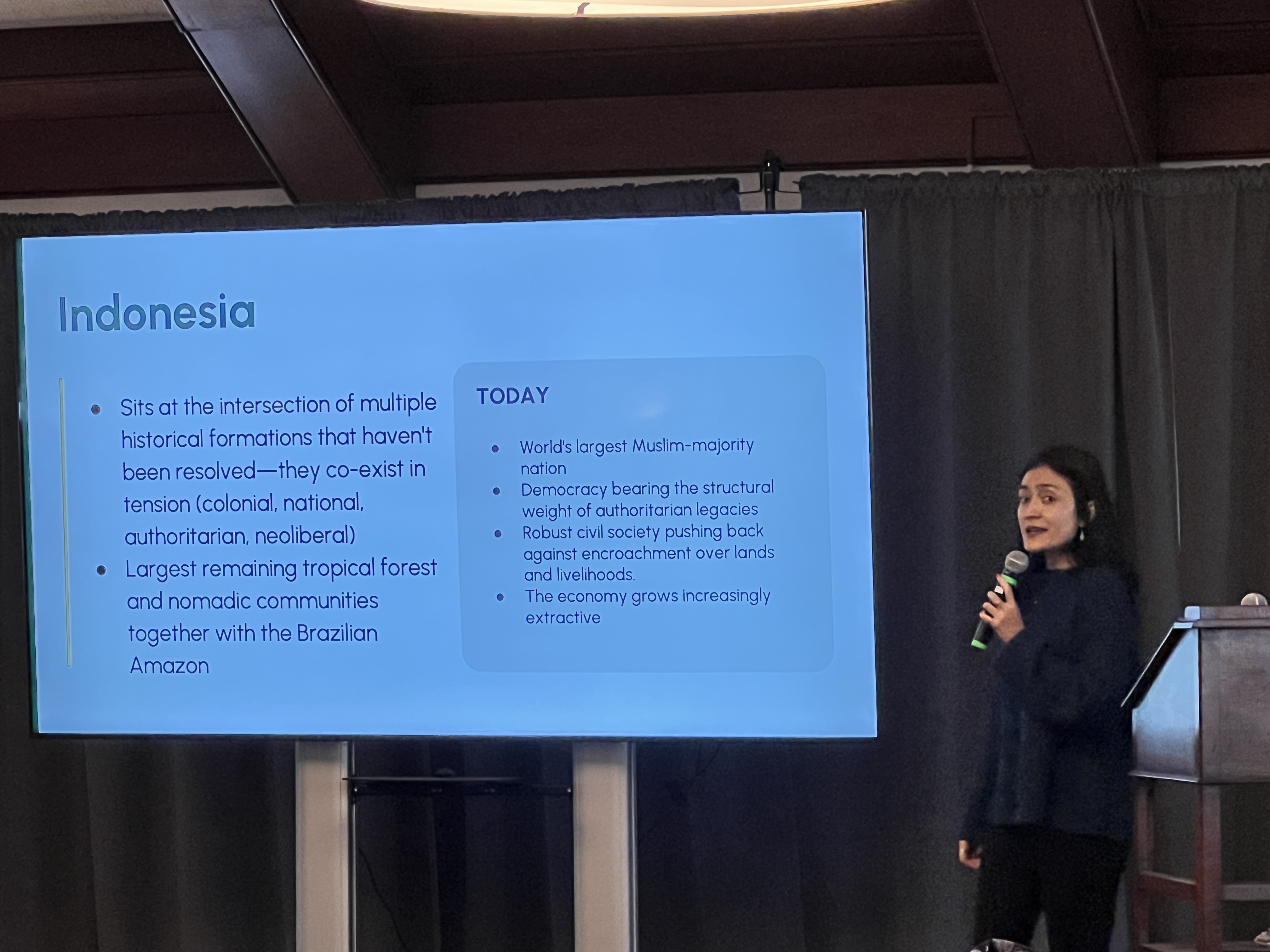
On January 14th, 2026, the Roberta Buffett Institute for Global Affairs and the Equality Developmentand Globalization Studies (EDGS) Program welcomed two Visiting Scholars, Inaya Rakhmani and Diatyka Widya Permata Yasih, to the Reading Room stage, for a talk on producing scholarship on Asia from within Asia. As the Director and Deputy Director, respectively, of the Asia Research Centre at the University of Indonesia, Drs. Rakhmani and Yasih focused their talk on the center’s unique approach to Asian Studies as a field of research, as well as the process of producing knowledge more broadly. They traced the historical thread of pressures and influences on higher education in Indonesia throughout the country’s recent history, highlighting British and Dutch colonialism, the brutal Communist purge of the Suharto regime, and the influence of U.S. interference in the Philippines. As a discipline, Asian Studies, even when practiced within Asia, has been heavily influenced by the dominant “Western” influence in the region.
Recently, however, the dominant forces driving scholarship in Indonesia have begun to waver in the face of multiple ongoing crises of economic and political identity in the Western world. Globally, higher education, though previously “neoliberalized” by heavy American influence, is beginning to resist the set of assumptions about the world and its place within it, challenging the legacies of the Cold War era and immediate aftermath and the way they have manifested in the university context. Rakhmani and Yasih argue that, at the intersection of multiple historical formations that have yet to resolve, Indonesia exists in a state of tension, with multiple historical and emergent forces vying for control over the national identity and vision for the future. A colonial and authoritarian past informs a somewhat nationalistic yet neoliberal present, presiding over the world’s largest Muslim-majority country with some of the largest tropical rainforest coverage globally and a substantial Indigenous community presence.
These competing forces offer an opportunity for Asian Studies to move beyond the boundaries of conventional disciplinary silos in the context of the retreating hegemony of the Western-dominated “liberal international order.” Rakhmani and Yasih have embarked on a trajectory of research that unites the influences of religion, democracy (or the lack thereof), technology, climate change, political economy, and more in a holistic analysis of modern phenomena with an ascendant Asia at its core. They trace knowledge formation through four main eras,
- Colonial Extraction
- Authoritarian Developmentalism
- Neoliberal Restructuring
- Interregnum
and pose the question: what possibilities for alternative knowledge could emerge from within these configurations?
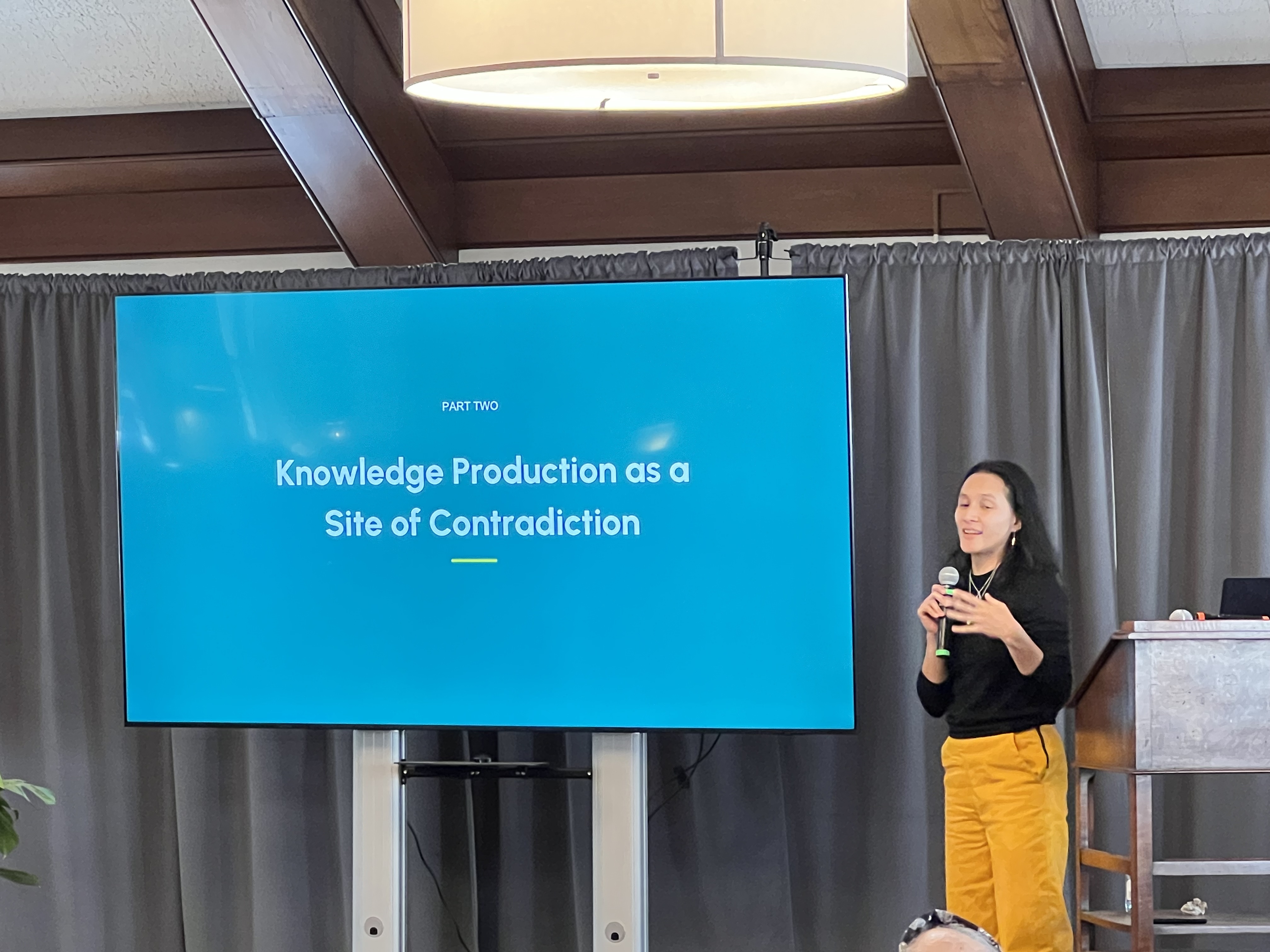 The second half of their talk dove deeper into this question of knowledge production as a site of contradiction. When influenced by, and even subservient to, the dominant political and economic order, knowledge production can be manipulated to legitimize a regime rather than challenge the assumptions upon which it is built. Saddled with heavy teaching and administrative workloads, scholars in Indonesia struggle to break out of their routines and disciplines, despite the fact that it is more important than ever that scholars break down those boundaries, both within Indonesia and around the world, according to Rakhmani and Yasih. Inherent in publicly and privately funded research is the presence of state and/or donor pressure that may prevent the formation of relationships between scholars and the subjects of their research. ARC has prioritized these direct relationships with those individuals to gain access and insight into problems they study, of which dominant state and donor forces may disapprove. In this way and others, the center alters conventional hierarchies of decision-making in research.
How else, then, does the ARC alter these hierarchies? Rakhmani and Yasih articulate four main strategies:
- Publishing: Supporting regional journals, open access, and multilingual scholarship
- Networks: Building South-South connections beyond traditional academic circuits
- Pedagogy: Co-learning with movement actors and establishing a teaching practice that centers local knowledge while cultivating global comparative imagination
- Solidarity: As discussed, connecting with movements and communities beyond the university context
They challenge the assumption that these strategies are the alternatives to academic work but rather believe they should be subsumed into regular academic practice.